
Dynamics
Channel compression
The transient moves. The instrument stays.

1 / 2
What It Does
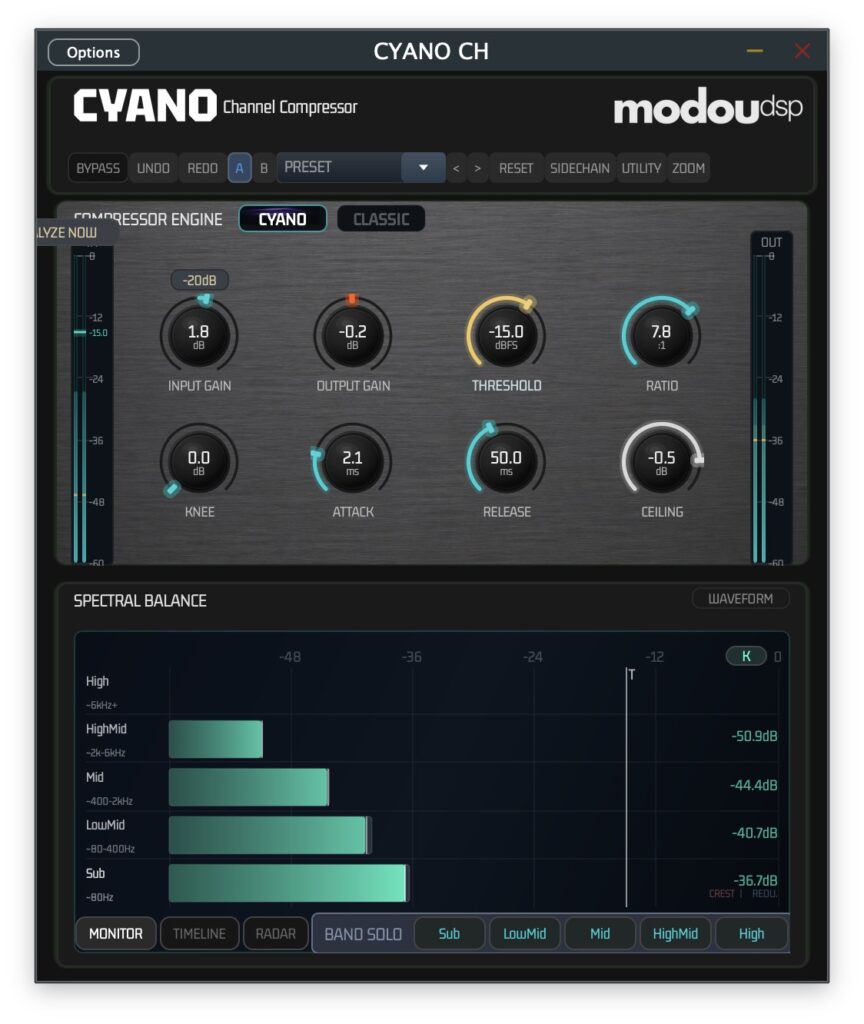
CYANO CH puts the CyanoCore split on a single channel. Below the threshold is the Bed — the body of the instrument, the sustain, the room it was recorded in — and it passes through at full level even while gain reduction is happening. Above it is the Crest, the transient you actually wanted to shape, and only that is reconstructed.
So the ratio stops being a compromise between control and life. You can take the peak down hard and the instrument keeps its size, because the part that gives it size was never in the signal path being reduced.
Why one is enough
The full mastering engine's compressor, unchanged, on a channel strip. Threshold, ratio, attack, release and knee are the same controls with the same behaviour — and both topologies come with them: CYANO when the source needs to stay whole, CLASSIC when the material wants a conventional character. A threshold line sits right on the input meter, so the boundary you're setting is visible against the signal you're setting it for. You also see what you did. Spectral Balance reads the source across five bands, the sliding waveform panels show input against output, and the level meters hold the whole picture at the edges of the section. When a channel needs to leave on its own, oversampling to 8×, the clipper and true-peak limiting are already there. VST3, AU, AAX and Standalone. One compressor, every track, nothing to swap in for the difficult ones.
Watch First
See It In Action
How It Works
Specification & Test Results
| Operating point | -12 dBFS swept sine, 48000 Hz | measured |
| Passband reference gain | -0.00 dB | measured |
| Gain at 1 kHz | -0.00 dB | measured |
| Max deviation from reference, 20 Hz–20 kHz | ±0.00 dB | derived |
| −3 dB points | low — · high — | derived |
| High-frequency roll-off | — | derived |
| Resonance | none above 0.5 dB | derived |
| Gain at 24 kHz, relative to reference (96 kHz sweep) | -0.00 dB | measured |
| Gain at 30 kHz, relative to reference (96 kHz sweep) | -0.00 dB | measured |
| Gain at 40 kHz, relative to reference (96 kHz sweep) | 0.00 dB | measured |
| Dynamic range (AES17-style, −60 dBFS THD+N, unweighted) | 209.6 dB | derived |
| Noise floor (silent input, unweighted RMS) | −∞ (digital silence) | measured |
| Max output level at THD+N ≤ 1 % | -3.3 dBFS | derived |
| Usable range (max level − noise floor) | — | derived |
| Formats | Details |
|---|---|
| Plug-in formats | VST3, AU, AAX, Standalone |
| Operating systems | macOS 11+ (Apple Silicon native), Windows 10/11 (64-bit) |
| License | 30-day trial (1 machine) · License for up to 3 machines, delivered instantly after purchase (email and Central at once), managed from your modou dsp account |
FAQ
Yes — every product gets a 30-day free trial. There's no separate trial build: download and install modou Central, then request your trial for CYANO CH from its License page.
Still stuck? MODU AI is in the corner of every page — it answers from the manuals and cites the section.
Sign in to search the manuals and ask MODU AI a question — it cites the exact section, every time.
Sign In