CYANO GLUE — The One-Panel Processor
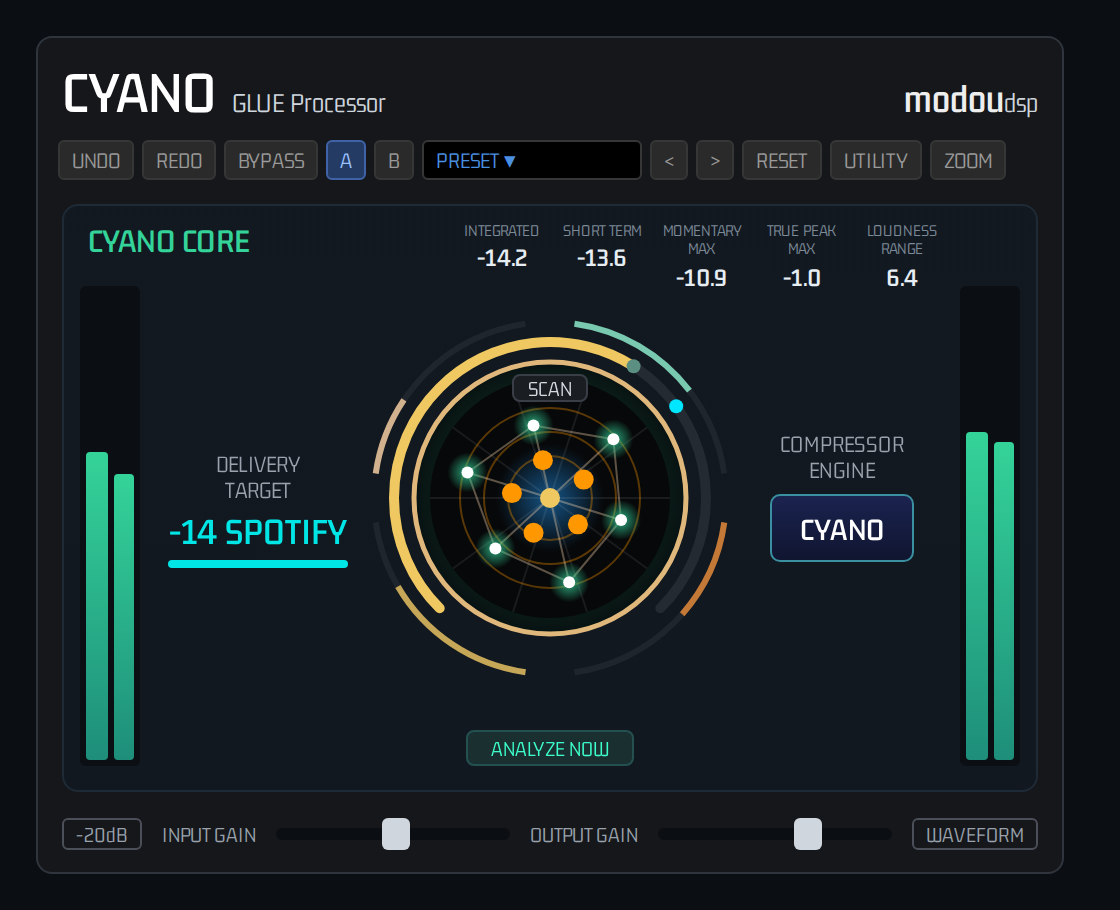
CYANO GLUE puts the essentials of CyanoCore™ on a single panel: a central orb for the threshold, a Delivery Target wheel and two gain faders.
Set the threshold so that it catches only the peaks — the Bed stays untouched — then raise OUTPUT GAIN until the wheel shows the delivery level you want. Ratio and timing are fixed, so there is nothing else to tune.
CYANO GLUE runs as VST3, AU, AAX and Standalone on mono or stereo tracks. It has no Master EQ, sidechain, Offline mastering or Album — those are found in CYANO and CYANO CH.
Core Philosophy — Reference, Not Peak
In CYANO, delivery target is not loudness measured around peak. In Stage A, Threshold you set becomes musical Reference Position, used as basis for Output Gain in Stage B. Therefore peak in Stage B is result, not control variable.
Reference → Translation → Delivery
Legacy: Peak → Limiter → Loudness / CYANO: Reference → Translation → Delivery.
Displayed target is not a value to chase but coordinate where your musical Bed was delivered.
Target = Bed Position + Output Gain
Example: Threshold = -14 dBFS → Reference = -14, Output Gain = +1 dB → Display = -13 dBFS. Even if True Peak -7 dBFS, Wheel shows -13. Because Peak is not Reference.
Product Family Overview
The CYANO Platform has three products that share the CyanoCore™ engine. This table lists what each one actually contains.
| Feature | CYANO | CYANO CH | CYANO GLUE |
|---|---|---|---|
| Role | Mastering processor | Channel compressor | One-panel processor |
| CYANO / CLASSIC engine | ✓ | ✓ | ✓ |
| Compressor controls | Full engine | 8 knobs | Threshold orb + gain faders (ratio and timing fixed) |
| External sidechain | — | ✓ | — |
| Master EQ & Spectral Balance | ✓ | ✓ | — |
| Delivery Target | ✓ | — | ✓ |
| Offline mastering, Album & Export | ✓ | — | — |
| Visualizers | Full set (Topology, Goniometer, Spectrogram, Timeline) | Spectral Balance (Monitor, Timeline, Radar) | Orb (SCAN, FIELD, RADAR) |
| Preset slots | A – D | A – B | A – B |
| −20 dB input pad | ✓ | ✓ | ✓ |
| Formats | VST3 · AU · AAX · Standalone | VST3 · AU · AAX · Standalone | VST3 · AU · AAX · Standalone |
Which Product Are You Using?
CYANO
Complete process. Reference implementation of CyanoCore™ with full control of Threshold, Ratio, Topology, Delivery.
CYANO GLUE
Set threshold to catch only peaks, adjust output gain to show target corresponding to output loudness.
CYANO CH
Understand full version first, then CYANO CH for channel dynamics. CLASSIC mode like conventional compressor and CYANO mode preserves Bed and controls only peaks.
Target Display Principle (All Products)
We do not chase Target. We display Target matching output RMS. Threshold creates Reference Position (Stage A), Output Gain translates it (Stage B). Displayed number is delivery target, not limiter result.
Introduction
Welcome to CYANO Platform — professional audio processor family based on CyanoCore™. Shares same philosophy and quality with different workflows. Delivery target is defined as translated reference position, not peak.
CYANO is dynamics processor designed from fundamentally different premise. Musical cohesion (Glue) is not achieved by compressing mix uniformly over time, but by preserving musical Foundation. While conventional compressor applies single gain envelope to entire mix signal whenever threshold is exceeded, CYANO splits signal into two domains and processes independently.
Origin of Name — Cyanoacrylate
Name comes from compound cyanoacrylate known as instant adhesive. Like instant adhesive that forms strong bond without adding volume or deforming objects, CYANO creates powerful musical Glue where instruments blend harmoniously without collapsing musical Bed.
Glue Principle
In audio, Glue means cognitive effect where mix instruments interact consistently like single organism. Traditional compression tries to mimic by attenuating all elements simultaneously, but result transforms music via unwanted envelope alteration. CYANO achieves true Glue by controlling only Crest region above threshold that breaks proportional relationships, while continuously maintaining Bed.
- Bed Preservation: All signals below threshold pass without alteration.
- Crest Optimization: Gain reduction only to excessive energy above threshold.
- Musical Glue: Cohesion achieved by preserving, not collapsing, relationships.
- Visual Topology: Check split state in real time.
What This Manual Covers
This document serves as both professional user guide and technical white paper. Reader is assumed professional engineer familiar with gain reduction, attack/release, loudness normalization.
Why Traditional Bus Compression Transforms Music
Most widespread misconception is that compressor only reduces peak signal exceeding threshold. In reality it never works that way.
What actually happens: Moment transient peak exceeds threshold, gain reduction is applied equally to entire signal coexisting in mix at that moment. Compressor cannot distinguish peak instrument that triggered event from other instruments in bus signal.
When -3 dBFS kick exceeds -6 dBFS threshold, vocal, reverb, strings not exceeding threshold are uniformly attenuated, envelope deformed.
- Envelope deformation, Loss of spatial depth, Cognitive density distortion, Relationship distortion
Fundamental architecture problem: Traditional compressor compresses everything whenever peak occurs. Larger gain reduction, more Bed damaged, structural limit unsolvable by attack/release tuning.
Why CYANO Exists
CYANO excludes global attenuation and achieves perfect musical Glue. Inspired by fact that arbitrary audio signal can be perfectly modeled as sum of two components.
A = B + C
A: Entire original signal
B (Bed): Sustained source below threshold, harmonics, root
C (Crest): Headroom-exhausting peak energy
Instead of shaving A, CYANO isolates: Output = B + C′
B: Passes without alteration, actual output uses B
C′: Optimized Crest
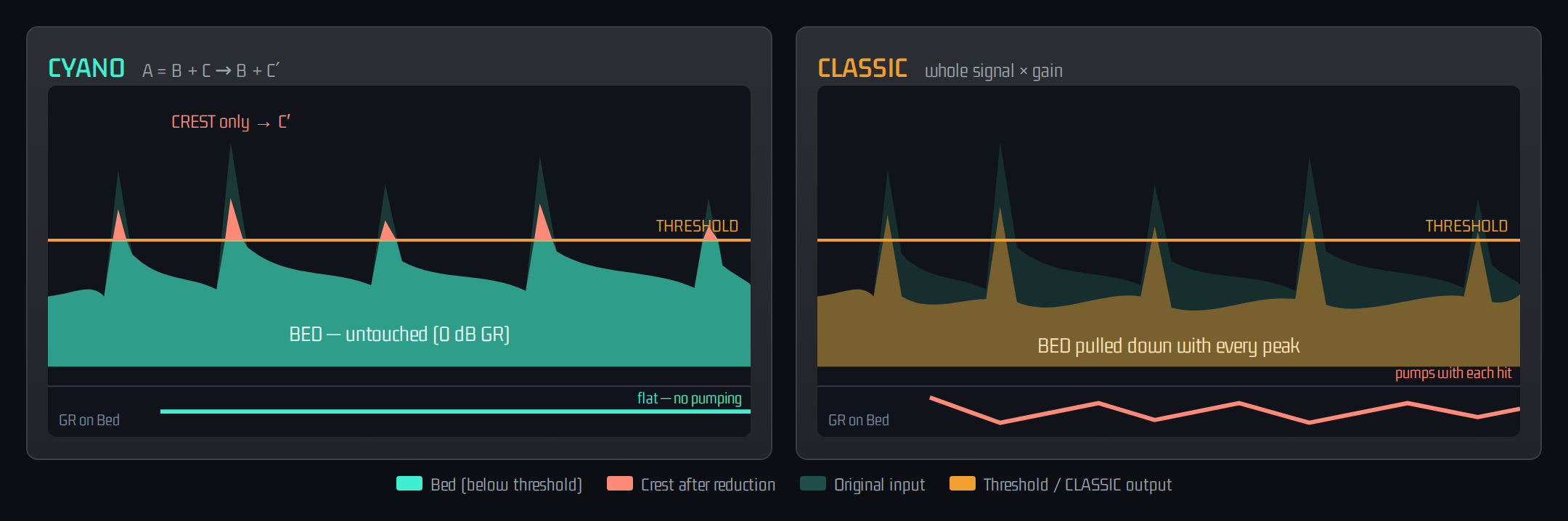
When kick transient occurs, gain reduction applies precisely only to Crest region exceeding threshold. Vocal or room (Bed) untouched, so no pumping.
Glue Through Preservation and Loudness is final stage only — musical optimization and delivery level perfectly separated.
Bed vs Crest
Threshold as Partition Boundary
In traditional compressor threshold is 'point where compression starts'. In CYANO definition is different and more precise: Partition Boundary dividing Bed and Crest domains.
Bed: Musical Foundation
All components below threshold such as instrument sustain body, reverb tail, noise floor, reaching output without gain reduction.
Crest: Excessive Peak Energy
Signal soaring beyond threshold such as transient hits, only region subject to dynamics operations. Also target for full utilization of headroom because peak is controlled.
Precise Split Process
B/C split calculated in real time at internal oversampling rate. Dual EMA smoothing blocks noise, ensuring clean sound during automation.
Steady-State Identity
With fixed threshold, split satisfies B + C = A at every sample, output perfectly matches input when no crest energy.
Core Concepts
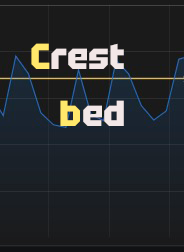
Bed: signal below threshold, always preserved foundation. Crest: signal above threshold, excessive energy peak subject to dynamics. Threshold: partition boundary level. Glue: natural cohesion obtained by protecting foundation. Target: final platform loudness spec and input/output gain adjustment guide.
Quick Start
Workflow Principle
Capture the Glue first with the threshold, then raise Output Gain until the wheel shows your delivery target. Do not match loudness first.
- Loop the most energetic part of the song or mix and keep the engine on CYANO.
- Drag the orb vertically to lower THRESHOLD from −0.1 dBFS. The teal line on the IN meter shows the Bed / Crest split — lower it until only the excess peaks cross it. Or click ANALYZE NOW: after a 3-second countdown (3, 2, 1, GO!) CYANO GLUE sets the threshold for you and returns OUTPUT GAIN to 0 dB.
- Stop just before the Bed starts to move. It should sound identical to the input.
- Raise OUTPUT GAIN and read the DELIVERY TARGET wheel. It follows the output loudness while you move a fader and holds the value shortly after you stop.
- Compare with BYPASS, and keep a variation in slot B.
Signs of Correct Glue
- Kick and snare tight and clear
- The Bed — reverb and sustained instruments — stays as in the input
- No artificial pumping
Interface
CYANO GLUE is one CYANO CORE panel below a header. The window opens at 150 % (about 771 × 579) and keeps its proportions when resized; the ZOOM menu offers 75, 100, 125, 150 and 200 %.
Header
UNDO and REDO, BYPASS, the A and B slots, the preset name with its previous / next buttons, RESET, UTILITY and ZOOM. See Presets, Slots & Utility.
CYANO CORE
- Loudness readouts — on the title row, at the right: INTEGRATED, SHORT TERM and MOMENTARY MAX in LUFS, TRUE PEAK MAX (L R) in dB and LOUDNESS RANGE in LU. Click any of them to reset the measurements.
- IN / OUT meters — stereo bars from −60 to 0 dB along the left and right walls of the panel. The IN meter carries the teal threshold line with its value; the OUT meter also shows the input peak as a faint ghost bar.
- The orb — drag it vertically to set THRESHOLD. Its small button cycles the views SCAN, FIELD and RADAR, and ANALYZE NOW sits below it.
- DELIVERY TARGET — the wheel to the left of the orb.
- COMPRESSOR ENGINE — a single button that shows the active engine, CYANO or CLASSIC; click it to switch.
Bottom row
The −20dB pad sits under the IN meter, INPUT GAIN and OUTPUT GAIN are horizontal faders in the middle, and WAVEFORM, with COMP CURVE directly below it, sits under the OUT meter.
WAVEFORM
Two panels slide in beside the orb: ORIGINAL (the input waveform) on the left and OUTPUT on the right. OUTPUT shows the legend IN, OUT, THR and GR over a 2000 ms window with a dB scale centred on the threshold; the mouse wheel zooms that scale (±3 to ±30 dB) and a double-click resets it. Dragging on the panels never moves the threshold. HIDE closes them.
COMP CURVE
Click COMP CURVE, directly below WAVEFORM under the OUT meter, to open the compressor view; HIDE closes it. Only one of the two opens at a time. Like WAVEFORM, it slides in as two panels beside the orb, in the same place and size as the waveform panels, so the orb stays visible; while they are open, the COMPRESSOR ENGINE button moves down below the panels.
- Left panel — transfer curve: the input → output curve from the live THRESHOLD and GLUE's fixed 8:1 ratio (−48 … 0 dB) fills the panel, and a point with a short trail moves on it with the current input peak and gain reduction.
- Right panel — readouts: ENGINE, THRESHOLD, RATIO, KNEE and INPUT, then BED GR, CREST GR and PEAK GR (CYANO) or SIGNAL GR and PEAK GR (CLASSIC), with a one-line summary of where gain reduction acts.
- CYANO: the band below the threshold is shaded as the untouched bed; only the crest above it is compressed. The live column at the point splits into the bed, the compressed crest and the gain reduction, and the GR readouts show the reduction of the crest alone.
- CLASSIC: the whole signal above the threshold is reduced. The live column splits into the scaled signal and the gain reduction.
CYANO CORE Controls
All controls are automatable. The orb, the faders and the pad are the only controls CYANO GLUE exposes.
| Control | Range | Default | Function |
|---|---|---|---|
| THRESHOLD (orb) | −40 … −0.1 dBFS | −4.0 dBFS | The Bed / Crest boundary. In CYANO mode only the signal above it is reduced. On the orb a gold arc marks the knob, a green arc the active split and a cyan arc the ANALYZE NOW reference. |
| INPUT GAIN | −24 … +24 dB | 0 dB | Gain after the −20dB pad, in front of the detector. Double-click returns to 0 dB. |
| OUTPUT GAIN | −24 … +24 dB | 0 dB | Final level — raise it until the DELIVERY TARGET wheel shows your target. Double-click returns to 0 dB. |
| ENGINE | CYANO · CLASSIC | CYANO | CYANO reduces only the Crest above the threshold; CLASSIC compresses the whole signal like a conventional compressor. |
| −20dB pad | Off · On | Off | Attenuates the input by 20 dB in front of INPUT GAIN. It stays active in BYPASS. |
Fixed values
RATIO is fixed at 8:1, ATTACK at about 10 ms and RELEASE at 162.5 ms. They cannot be changed. KNEE, CEILING, LOOKAHEAD and MIX have no control in CYANO GLUE and keep their default values (KNEE 0 dB, CEILING −0.1 dB, LOOKAHEAD 1.5 ms, MIX 100 %); the lookahead adds the same amount of latency, which CYANO GLUE reports to the host.
ANALYZE NOW
Click ANALYZE NOW to let CYANO GLUE find a threshold. A countdown of 3, 2, 1, GO! runs for 3 seconds while the plug-in follows the highest peak and the average level of the incoming signal. At GO! it sets THRESHOLD to a point between the two — weighted 70 % toward the peak and 30 % toward the average — raised by the CP AUTO BIAS (UTILITY, 0 to 4 dB, default 2 dB). The click also returns OUTPUT GAIN to 0 dB. Play the loudest, most representative passage while it runs.
Processing Modes
CYANO Mode: A = B + C topology, preserves sustain and reverb, maintains proportional relationships, builds best musical glue.
CLASSIC Mode: Traditional feed-forward compressor applies uniform gain reduction to entire signal. Use for pumping stylization.
| Feature | CYANO | CLASSIC |
|---|---|---|
| Bed attenuation during GR | None — 100% preserved | Yes — entire simultaneous |
| Crest peak target control | Supported | Not supported — whole batch |
| Artificial pumping | Structurally impossible | Always present (setting dependent) |
Delivery Target
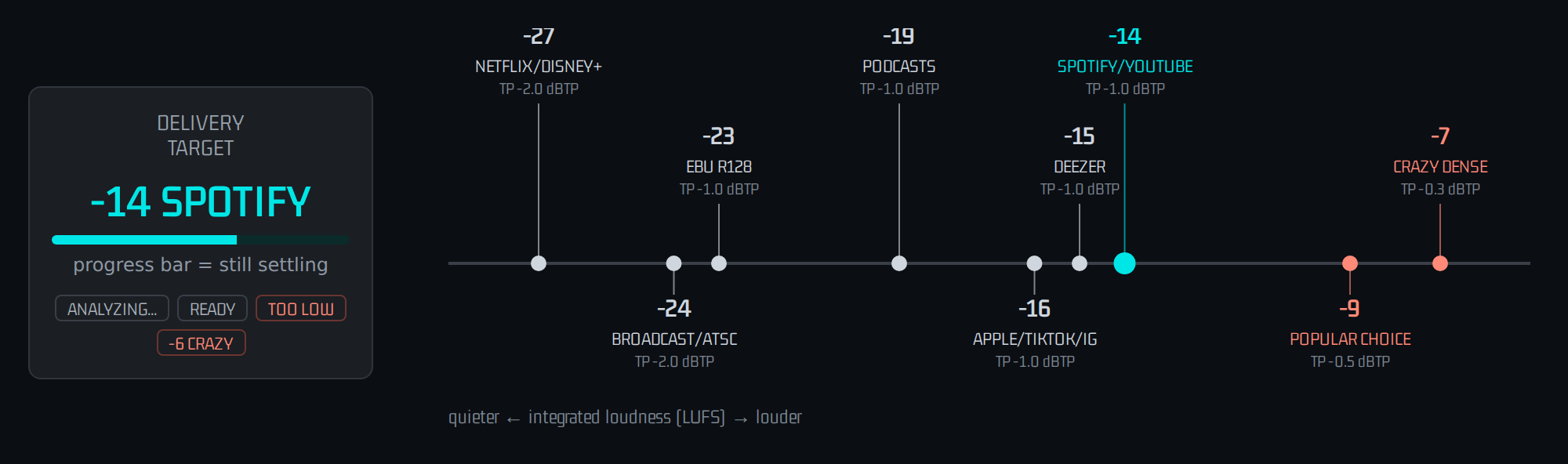
The DELIVERY TARGET wheel is a guide, not a control: it has no mouse interaction and never changes the sound or the threshold. It tells you where the output loudness currently sits relative to the built-in targets.
| Target | Integrated loudness | Reference true-peak ceiling |
|---|---|---|
| NETFLIX / DISNEY+ | −27 LUFS | −2.0 dBTP |
| BROADCAST / ATSC | −24 LUFS | −2.0 dBTP |
| EBU R128 | −23 LUFS | −1.0 dBTP |
| PODCASTS | −19 LUFS | −1.0 dBTP |
| APPLE / TIKTOK / IG | −16 LUFS | −1.0 dBTP |
| DEEZER | −15 LUFS | −1.0 dBTP |
| SPOTIFY / YOUTUBE | −14 LUFS | −1.0 dBTP |
| POPULAR CHOICE | −9 LUFS | −0.5 dBTP |
| CRAZY DENSE | −7 LUFS | −0.3 dBTP |
How the wheel behaves
- After you move INPUT GAIN or OUTPUT GAIN, the wheel follows the momentary output loudness while you move and holds the value 400 ms after you stop.
- A thin bar under the number fills while the value is still settling.
- Below −30 LUFS the wheel reads TOO LOW. From there up to −7 LUFS it snaps to the nearest target and shows the number with the short name, for example −14 SPOTIFY. At −7 LUFS and above it shows the measured value; at −6 LUFS and above it reads CRAZY.
- While the wheel is still scrolling it shows ANALYZING….
CYANO GLUE shows loudness only. It does not change its own CEILING for a target, so check the true-peak limit of your final stage.
Presets, Slots & Utility
Header
- UNDO / REDO — step through the last 32 changes.
- BYPASS — passes the dry signal, aligned to the plug-in's latency. Without an active licence the button is disabled and forced ON (see UTILITY ▸ LICENSE). In the default UNITY mode bypass skips INPUT and OUTPUT GAIN; with BYPASS MODE = GAIN they still apply. The −20dB pad is always applied.
- A / B — two complete settings to compare (see below).
- PRESET — a menu with Save Current, Save As, Rename, Delete and Refresh List, followed by the Factory and User presets; the < and > buttons step through the list. Loading a preset leaves INPUT GAIN and OUTPUT GAIN as they are.
- RESET — sets OUTPUT GAIN to 0 dB, selects the CYANO engine and restores the settings that have no control here (CEILING −0.3 dB, clipper Transparent, true peak On, oversampling 4x). THRESHOLD, INPUT GAIN and the pad are not changed. It also resets the DELIVERY TARGET wheel.
- UTILITY, ZOOM — see the table below and the Interface section.
A / B slots
A and B each store a complete setting — every parameter of the plug-in. Switching slots saves the one you leave and recalls the other. The first time you enter a slot it continues from the settings you were just using, so you can make a variation and compare. Long-press A or B for Copy, Paste and Clear; Clear returns that slot to its defaults. BYPASS is not part of a slot.
UTILITY
| Control | Options |
|---|---|
| CP AUTO BIAS | 0 … 4 dB (default 2 dB) — added to the ANALYZE NOW result |
| BYPASS MODE | UNITY (default) · GAIN |
| OVERSAMPLING | 1x · 2x · 4x · 8x — the CYANO engine never runs below 4x |
| TRUE PEAK | Off · On (default). Measurement only: On reads inter-sample true peaks, Off reads sample peaks |
| CLIPPER MODE | Off · Transparent (default, 0.3 dB knee) · Soft (1.5 dB) · Medium (3 dB) · Hard (0.05 dB). A soft clipper in front of the CEILING limit |
MANUAL, YOUTUBE, INSTAGRAM and HELP open web pages. LICENSE switches to the licence tab: License Key and Email, the hardware ID, and the buttons TRIAL, ACTIVATE, PURCHASE and MANAGEMENT. The status reads NO LICENSE (Demo Mode – visual only), TRIAL (days left), ACTIVE LICENSE or LICENSE EXPIRED.
Design Philosophy
Pumping Essence
Traditional compressor's global attenuation pushes entire mix volume down when peak engaged then forced recovery during release, creating pumping artifact where reverb fluctuates. CYANO does not shave Bed in first place so there is no reverb to recover, structurally blocking pumping.
Envelope Collapse Mechanism
Existing compression applies attenuation curve to entire source during compression time, transforming even envelope of instruments below threshold. CYANO's Bed preservation delivers waveform envelope of below-threshold source to output 1:1 without alteration, delivering touch and texture original.
Crest and Headroom Exhaustion
Sharp momentary peaks not contributing to perceived loudness monopolize digital ceiling and hinder overall volume. By precisely handling only wasteful Crest peaks, average loudness (Crest Factor control) can be safely expanded without damaging musical foundation. Because Bed below peak moment is preserved, aggressive Crest control is possible.
Guarding Instrument Relationships
Humans perceive mix by comprehensive analysis of relationships. While traditional compressor inevitably distorts this balanced balance at every peak by compressor operation, CYANO keeps spatial ambience and reverb harmonics immovable like concrete and cleans only upper peaks, inducing overwhelmingly natural and musical result.
Engineers evaluate CYANO-processed sound as 'only solidity mounted as mix itself without stuffy or artificial smell unique to compressor' — possible because artifact factor where instrument foundation was unfairly shaved and envelope collapsed was structurally excised, core sound engineering aesthetics of CYANO.
Founding Principle
Essential reason for CYANO existence is not to make loudness thug that indiscriminately crushes sound. It is to perfectly preserve musical deep structure (Relationships) while wisely optimizing only excessive Crest energy destroying headroom. Loudness is following bonus, musical emotion is guarded by Bed preservation. Used innovatively in delivery stage of modern mastering that controls overall loudness while controlling only peaks and reducing dynamic range.
The Science Behind CYANO
What Does “Glue” Really Mean?
The word Glue has been used in professional audio engineering for decades.
Engineers often describe a good bus compressor by saying:
“It glues the mix together.”
However, very few explain what is actually being glued.
CYANO approaches this question from a different perspective.
- Glue is not the act of making sounds louder.
- Glue is not excessive compression.
- Glue is not coloration or harmonic enhancement.
Instead, Glue is the process of preserving the natural relationship between musical elements while improving their overall stability.
Glue Is About Musical Cohesion
A musical mix is composed of many independent sources.
- Kick
- Bass
- Snare
- Vocals
- Guitars
- Strings
- Reverbs
Each source has its own dynamics, timing, and envelope.
Although every instrument behaves independently, our hearing ultimately perceives the entire mix as a single musical event.
The stronger this perception becomes, the more listeners describe the mix as
tight
cohesive
solid
glued together
CYANO calls this property Musical Cohesion.
Glue Is Not Compression
Traditional bus compressors create Glue indirectly.
They reduce dynamic range, causing peaks to become more controlled and making the overall mix appear more unified.
However, compression itself is not the definition of Glue.
In fact, excessive compression can reduce cohesion by damaging the natural relationships between musical elements.
CYANO therefore separates the concept of compression from the concept of Glue.
Compression is only one possible tool.
Glue is the final perceptual result.
The Bed–Crest Topology
Bed
The Bed represents the continuous foundation of the music.
It contains:
- body
- sustain
- ambience
- density
- musical continuity
The Bed forms the structural foundation of the mix.
Crest
The Crest contains transient energy.
Examples include:
- drum attacks
- pick attacks
- consonants
- accents
- short peaks
These elements provide punch and articulation.
Instead of processing the entire signal equally, CYANO treats these two components differently.
The Bed remains preserved whenever possible, while only the Crest is controlled when necessary.
This minimizes unnecessary changes to the musical foundation.
Why This Matters
Listeners rarely describe a great mix by saying
“The peaks are 2 dB lower.”
Instead they describe it as
- smoother
- tighter
- more connected
- more stable
- easier to listen to
These impressions arise because the temporal relationship between musical elements has become more consistent.
The objective is not simply lower peaks.
The objective is greater musical stability.
CYANO's Philosophy
CYANO is designed around one simple principle:
Move the loudness of the music without changing the music itself.
Rather than continuously changing gain throughout the song, CYANO aims to preserve the musical structure while controlling only the energy that requires protection.
The result is a mastering process that maintains the original musical flow while providing the stability expected from modern production.
A Different View of Glue
Many processors attempt to create Glue by increasing compression.
CYANO instead attempts to preserve the relationships that already exist within the mix.
When those relationships remain intact while excessive transient energy is controlled, the entire mix becomes more coherent.
That coherence is what musicians and engineers have traditionally described as Glue.
Summary
CYANO defines Glue as:
The increase of musical cohesion through stabilization of temporal and dynamic relationships while preserving the fundamental structure of the mix.
In practice, this means:
- Preserve the musical foundation (Bed)
- Control only excessive transient energy (Crest)
- Maintain the natural flow of the performance
- Improve perceived stability without unnecessary coloration
This philosophy forms the foundation of every processor built on the CYANO Platform.
FAQ
What does CYANO GLUE actually do? In CYANO mode it splits the signal at the threshold, reduces only the Crest above it with a fixed 8:1 ratio and recombines it with the untouched Bed. CLASSIC mode compresses the whole signal instead.
Can I change ratio, attack or release? No. They are fixed in CYANO GLUE (8:1, about 10 ms and 162.5 ms). For full control use CYANO; for a channel compressor with all eight knobs use CYANO CH.
Does the DELIVERY TARGET wheel change the sound? No. It is a display guide for OUTPUT GAIN and has no effect on the threshold or the audio.
Why does the wheel show TOO LOW? The output loudness is below −30 LUFS, or no signal has played yet. Play a louder passage and move a gain fader.
What does ANALYZE NOW do? It listens for 3 seconds, sets THRESHOLD from the signal's peak and average level plus the CP AUTO BIAS, and returns OUTPUT GAIN to 0 dB.
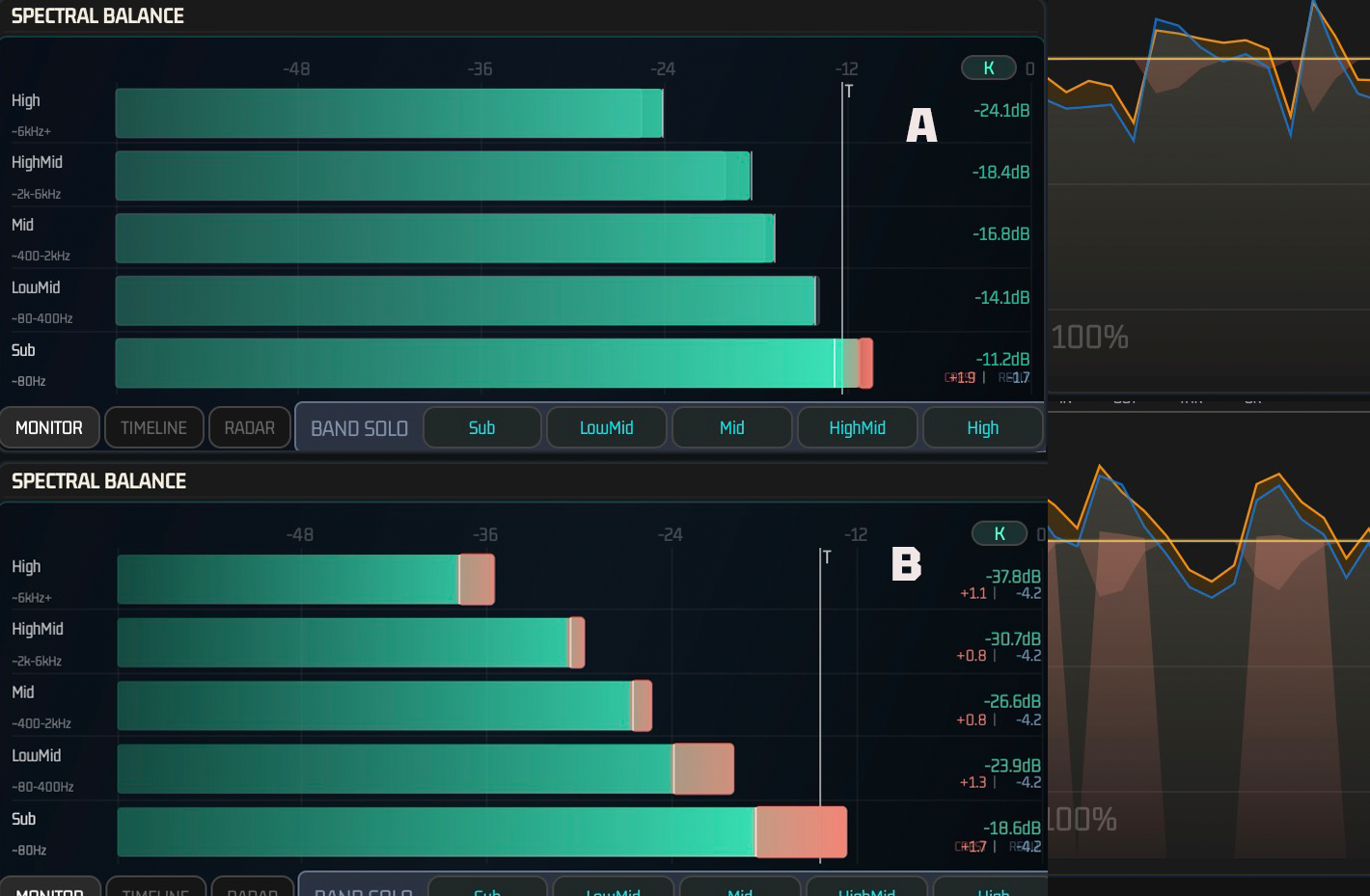
Is there a Master EQ? No. The Master EQ and Spectral Balance are in CYANO and CYANO CH.
Where are oversampling, true peak and the clipper? In UTILITY. They are not on the main panel.
Troubleshooting
Sound pumps or feels over-compressed
Cause: THRESHOLD is too low, so body that should stay Bed is treated as Crest. Solution: raise THRESHOLD until it is stable, and check that the engine is CYANO, not CLASSIC.
No gain reduction, the plug-in seems inactive
Cause: THRESHOLD is above the peaks. Solution: lower it until the threshold line on the IN meter (or THR in WAVEFORM) sits at the peaks. Also check the engine, BYPASS and the licence.
The wheel shows TOO LOW or ANALYZING…
Cause: the output is below −30 LUFS, or the value is still settling. Solution: play a louder passage, move a gain fader and wait a moment after you let go.
The ANALYZE NOW result is too low or too high
Cause: the passage you played was not representative. Solution: run it again on the loudest part, change CP AUTO BIAS in UTILITY (0 to 4 dB) or fine-tune the orb by hand.
BYPASS is lit and cannot be switched off
Cause: no active licence — the button is disabled and forced ON. Solution: open UTILITY ▸ LICENSE and activate or start a trial.
Level differs from bypass
Cause: the −20dB pad or OUTPUT GAIN. Solution: check both. In the default UNITY mode BYPASS skips INPUT and OUTPUT GAIN, so the comparison is not level-matched.
Technical Appendix
Signal Routing Path
Audio Input → −20dB pad → INPUT GAIN → Stage A (Bed / Crest split at the threshold, Crest-only compression, recombination) → OUTPUT GAIN → Clipper → CEILING limit → Output. There is no Master EQ stage.
Specification
| Specification | Value |
|---|---|
| Plug-in formats | VST3, AU, AAX, Standalone |
| Channels | Mono or stereo (input = output); no sidechain input |
| Window | Opens at 150 % (about 771 × 579), resizable from 75 % to 200 % with fixed proportions |
| Fixed compressor values | Ratio 8:1, attack about 10 ms, release 162.5 ms |
| Oversampling | 1x / 2x / 4x / 8x selectable in UTILITY; the CYANO engine runs at 4x or higher |
| Threshold smoothing | 15 ms |
| Latency | Oversampler latency plus lookahead (1.5 ms by default), reported to the host |