01 — The standard

We don't want fewer choices. We want better ones.

  • Use another EQ.
  • Use another compressor.
  • Use another reverb.

All of it stays on the table. But if you reach for ours —

One should be enough of its kind.

Not a claim about every plugin you own — a standard each modou dsp product has to meet on its own. Choose our EQ and you should have no reason to go looking for another one.

02 — Experience

Built by someone who actually mixes.

  • Writes Books on audio and mixing.
  • Teaches Lectures and courses.
  • Mixes Real sessions, real deadlines.
  • Builds DSP for the problems those sessions keep producing.

Not DSP designed from theory alone — DSP that grew out of real sessions.

03 — Products

Enough of its kind.

Each product has one job — and has to be a complete answer to it.

CYANO · Dynamics

Move the loudness, not the music.

Mastering loudness control

Every loudness decision still gets made on faith. You push into a limiter, watch a number climb, and hope the sustain, the reverb tails, and the weight of the low end survived the trip. Conventional gain reduction moves the entire signal at once — so the foundation of the music pays for every peak you wanted to control. Nothing on screen tells you what was preserved and what was flattened. You find that out later, on someone else's speakers.

CYANO splits your master at a single point and treats the two halves as different materials. Everything below the threshold is the Bed — the sustain, the room, the body of the mix — and it is passed through untouched, at full level, even while gain reduction is happening. Everything above it is the Crest, and only that is reconstructed. That makes the threshold something other than a trigger. It becomes a musical Reference Position: the coordinate your mix is delivered from, with Output Gain translating it to the target you need. Peak stops being the control variable and becomes what it always should have been — a result. Because the Bed is never attenuated, pumping isn't tuned out of the signal path. It's structurally impossible.


How CYANO works →

EQOMP · Dynamics

A curve, not a line.

Frequency-selective dynamics control

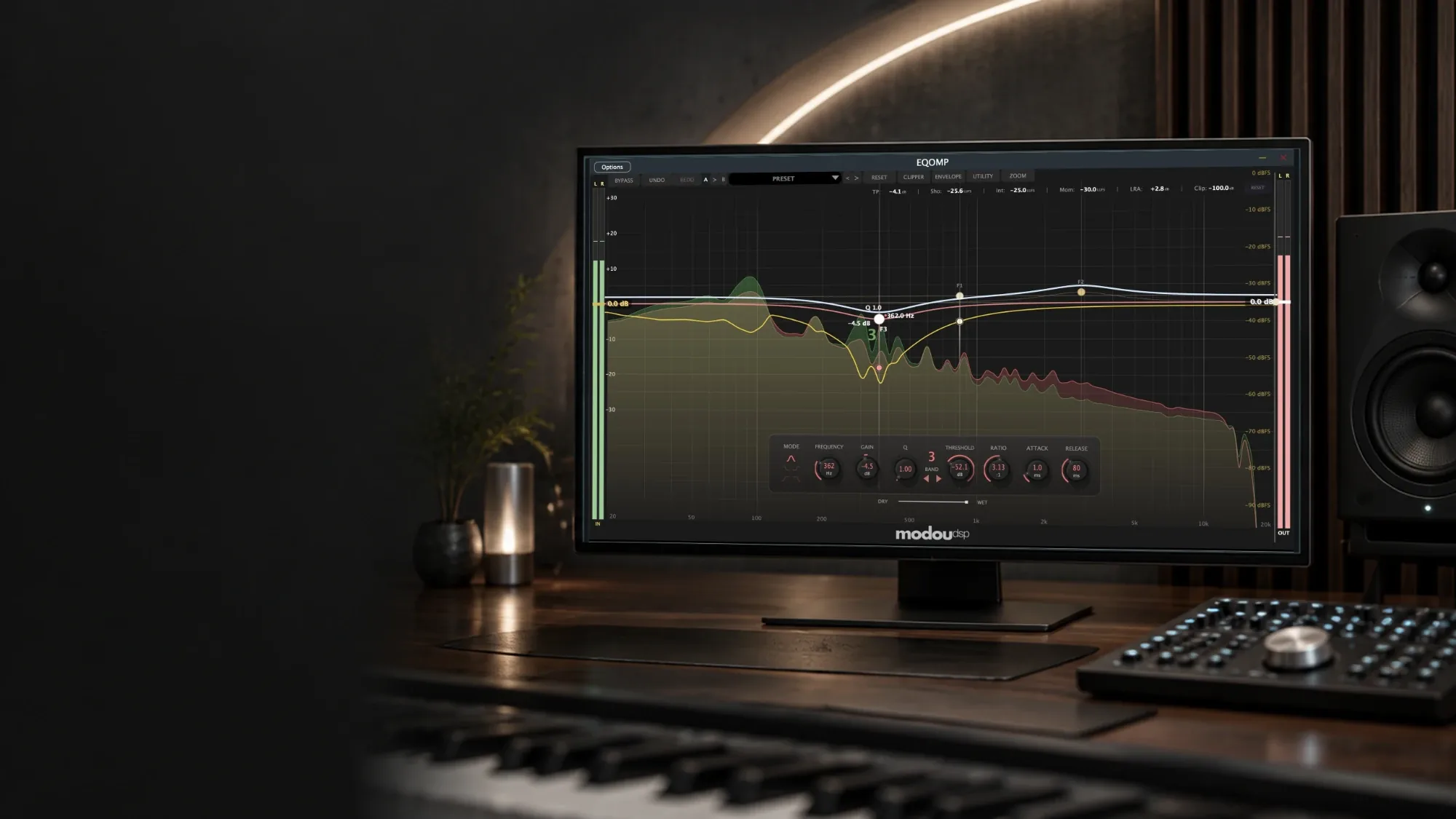
Most Dynamic EQ makes you set where the problem is — a threshold, a band, a fixed rule — before it ever hears the signal. EQOMP does it the other way around: it traces the actual signal, up to 2,048 points per buffer, to find where the problem is and follow it as it moves.

Instead of asking you to set a threshold and hoping it matches the signal, EQOMP traces the signal first. Every band you place becomes a listening reference — a point from which EQOMP tracks moving energy and harmonic structure in the actual audio — and the threshold curve it builds follows what it finds, not a rule you guessed in advance.

Audio Input → Input Gain → Combined Threshold Curve calculated (all active Dynamic EQ bands merged into one bell-weighted FFT threshold curve, ~2,048 bins) → Per-Band EQ + Dynamics processing (each enabled band filters its range and reacts against the shared threshold curve; solo/mute respected) → Single Band layer (optional, full-spectrum compressor pass using the same threshold logic) → Dry/Wet blend (latency-compensated dry signal mixed with processed wet signal) → Output Gain → Auto Clipper (optional, transparent ceiling stage) → Audio Output
How EQOMP works →

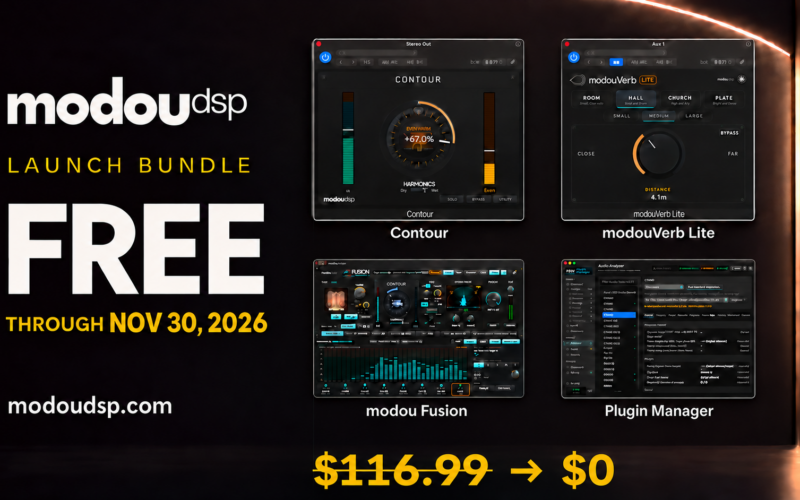
CONTOUR · EQ

Colour with a shape.

Harmonic colouring

Harmonic colour is easy to hear—and hard to see. When you add harmonic content, you can hear that the sound has changed. But without a clear view of which harmonics are being introduced and how they are shaped, it can be difficult to make a deliberate choice. The process becomes repeated adjustment and A/B listening.

CONTOUR gives harmonic colour a shape you can hear and see. It analyzes the incoming signal, shapes the harmonic content being added, and lets you follow the process from input to output: IN → ANL → HRM → MIX → OUT

IN → ANL → HRM → MIX → OUT
How CONTOUR works →

04 — Technology

Different thinking.
Different DSP.

What we build is not a new interface. We rethink how sound is understood in the first place, then build that thinking into DSP.

  1. 01 Listen Take in the signal as it actually is.
  2. 02 Analyze Extract what is really happening in it.
  3. 03 Understand Decide what that means for this material.
  4. 04 Process Act on that decision, not on a fixed curve.

Keep creating with
whatever else you love.

What's here now is ready. What's next is already underway — new things that didn't exist before, and leaner ways to do the ones that did.

Whether ours belongs in your set is not something we can argue you into. Every download is free and runs for thirty days — download and install modou Central, then start the trial from its License page. A license then covers three machines on the same email and code, so the studio, the laptop and home are all one purchase.

modou dsp

One should be enough of its kind.

Ask MODU AI

Sign in to search the manuals and ask MODU AI a question — it cites the exact section, every time.

Sign In