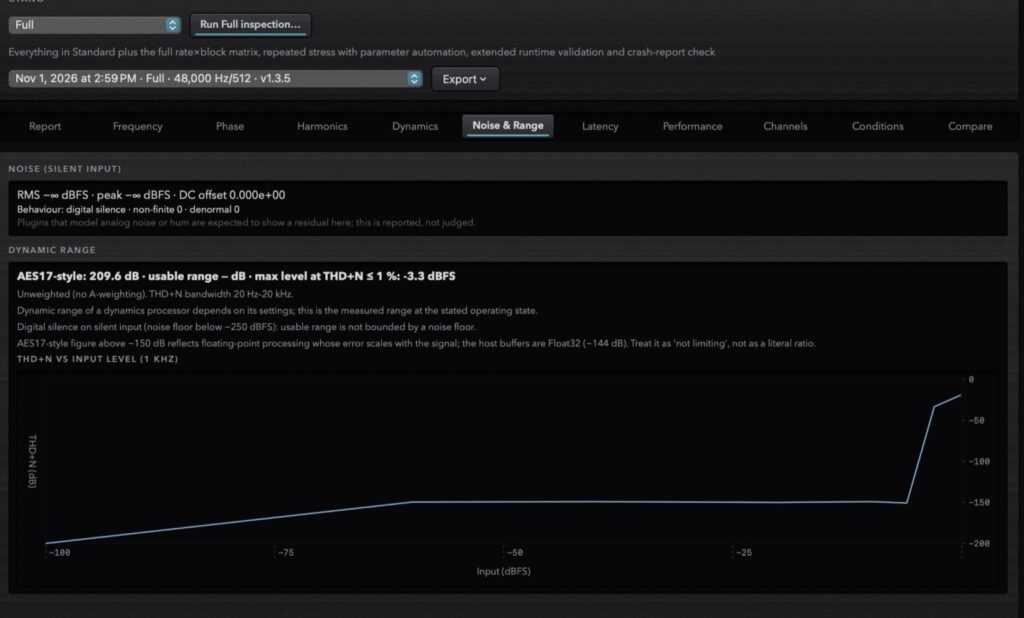
In a plugin-analyzer measurement of CYANO, the THD+N vs input level graph is flat at about −150 dB, then jumps sharply around −4 dBFS. “Max level at THD+N ≤ 1 %” is only −3.3 dBFS. Is something wrong?
No. This is CYANO working as a mastering processor with its default settings.
Flat region, about −60 to −5 dBFS (≈ −150 dB THD+N). This is CYANO’s processing range, and it is effectively distortion-free. The figure sits near the limit of the host’s 32-bit floating-point audio buffers (about −144 dB), so the signal path is not adding audible distortion.
Sharp rise just above −4 dBFS. By default, CYANO’s SPLIT threshold is −4 dBFS, with a ratio of 8:1 and a hard knee (0 dB). A 1 kHz test sine whose peaks pass −4 dBFS gets those peaks compressed quickly by the crest stage. On a pure sine, that shows up as harmonic distortion. That is why the 1 % THD+N point lands at −3.3 dBFS, just above the threshold. Music is handled differently: the material below the threshold (the “bed”) passes untouched, and only the peaks are shaped.
Near 0 dBFS (about −20 dB THD+N). Here the brickwall limiter (ceiling −0.1 dB, True Peak on) and the clipper also act on the signal. This is intentional peak control, not a fault.
Slope below −60 dBFS (−200 → −150 dB). This is the analyzer’s own measurement floor. It is not noise produced by CYANO, and it is far below audibility.